If you’ve ever worked with high-density fiber optic networks, chances are you’ve encountered MPO/MTP adapter cables—those unassuming yet critical pieces that keep data flowing in data centers, cloud infrastructures, and 5G backhauls. As someone who’s spent the last 12 years as part of a team supplying these cables to clients across industries, I’ve lost count of how many times a client’s engineering team has called me, frustrated, because their new MPO link isn’t working. Nine times out of ten, the problem traces back to polarity: the way the fiber strands align in the MPO connectors. Most people new to MPO/MTP tech see polarity as a confusing afterthought, but it’s actually the backbone of how these high-bandwidth cables perform. Today, I’m breaking down how MPO polarity works, why it matters so much, and how we as suppliers design our adapter cables to avoid common polarity headaches. MPO/MTP Adapter Cable
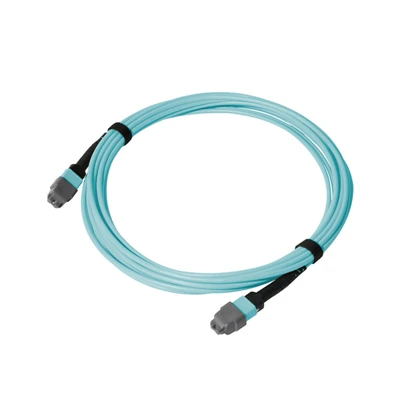
First, let’s ground this in what MPO connectors are, for anyone who’s still getting their feet wet. MPO (Multi-fiber Push On) is the standard for high-density fiber connections, with 12, 24, or even 36 fiber strands packed into a single connector, compared to the 1 or 4 strands of a standard LC or SC. The “MTP” brand is actually a registered version of MPO, made by US Conec, but most people use the terms interchangeably these days. Each fiber in an MPO connector is numbered, usually starting at pin 1 on the top-left of the keyed side of the connector. That numbering is non-negotiable for polarity—if you mix up which strand is sending or receiving, the light signal won’t transfer from one end to the other. That’s the core of polarity: matching the transmit (Tx) and receive (Rx) strands between two MPO connectors so data moves correctly.
Now, why is polarity such a big deal? Let’s say you have a 12-fiber MPO cable running from a switch panel to a server rack. Each switch port sends a signal down one fiber, and that signal has to land on the corresponding receive port on the server. If polarity is wrong, signal loss spikes, you get high bit error rates (BER), or the link won’t come up at all. For 5G and data centers, where a single outage can cost a company thousands of dollars an hour, polarity isn’t a minor detail—it’s the difference between a network running at 100Gbps and one that’s down.
So how do the different types of polarity actually work? Most MPO adapter cables fall into three main polarity types: Type A, Type B, and Type C. Let’s go through each one, because this is where a lot of miscommunication happens between buyers and suppliers.
Type A polarity is the most straightforward, especially for point-to-point connections. Also called “straight-through” polarity, Type A matches pin 1 on the first MPO connector to pin 1 on the second. No twists, no reverses—just a straight line. So if your first connector’s pin 1 is Tx, it connects directly to the second connector’s pin 1 Rx. This is the go-to for simple links, like connecting two racks within the same data center. The downside? It only works for 12-fiber, 24-fiber, and 36-fiber links that don’t require crossing signals. But when you start dealing with active equipment like QSFP transceivers, Type A isn’t enough.
That’s where Type B polarity comes in, sometimes called “flip” polarity. Type B reverses the strand order, so pin 1 on the first connector maps to pin 12 on the second. This is designed for when you’re connecting two MPO ports on active equipment that use paired Tx/Rx sets. For example, a QSFP28 module has four Tx lanes and four Rx lanes, and Type B ensures each Tx from the module pairs with the correct Rx on the opposite end. A common mistake here is mixing up Type A and Type B for a QSFP link—we get at least one query a month from a client who installed a Type A cable, and suddenly their 100G connection won’t work. They call us panicking, and we walk them through swapping to Type B, which fixes it 9 times out of 10.
Then there’s Type C polarity, used for cascaded or fan-out connections. Type C rearranges the strands into two groups of six, so pins 1-6 on the first connector map to pins 7-12 on the second, and vice versa. This is useful when you’re breaking out a single MPO cable into multiple LC connections, or when you need to link multiple MPO segments in a chain. I once worked with a client building a 500-rack data center in Texas, and they needed to cascade MPO links across three floors. They tried Type B first, but it caused signal leakage between cascaded segments, so switching to Type C solved their problem without requiring a full rework of the cable runs.
Now, here’s where adapter cables come in—these are the unsung heroes for adjusting polarity on the fly, without having to replace entire long cable runs. Let’s say you have a permanent MPO cable installed in your data center, but you need to reconfigure a rack, and the existing polarity doesn’t match your new switch ports. Instead of pulling 500 feet of cable to run a new one, you can use an MPO polarity adapter to adjust the signal path. There are two main types of polarity adapters: fixed and modular. Fixed adapters are pre-configured for a specific polarity type, like Type B, and they plug directly between two MPO connectors to flip the strand order. Modular adapters are more flexible, letting you swap out inserts to switch between Type A, B, or C as needed—perfect for clients who do a lot of frequent network reconfigurations.
But as a supplier, I can tell you that not all adapters are created equal. A lot of cheap, no-name adapters on the market skip critical quality checks that affect polarity. For example, if the adapter’s internal guide pins are misaligned by even 0.1mm, two fiber strands won’t line up correctly, leading to signal loss even if the polarity type is right. I once had a client send back a batch of 100 adapters they’d bought from a overseas supplier, saying they were getting random BER spikes. We tested them in our lab, and found that 12% of the adapters had guide pins that were off-center, so the fibers were shifting when the connector was inserted. All of our adapters go through three rounds of pin alignment testing, and we use high-grade ceramic sleeves instead of plastic, which is more durable and keeps the strands aligned for thousands of insertions. That’s the difference between a $2 adapter and a $12 adapter—we’re not just selling a part, we’re selling reliability that keeps our clients’ networks up.
Another thing that’s often overlooked is polarity in parallel MPO connections, like for 400G or 800G networks. Today, most high-speed networks use parallel MPO, meaning 8 or 16 fiber strands running in parallel to carry data. For these, you have to make sure not just that the total polarity is correct, but that each individual lane is aligned. I had a client last year building a new 800G backbone, and they tried to use a generic MPO cable they’d bought online. The total polarity was Type B, but one of the lanes was off by two pins, so the entire link was running at half speed. When they brought it to us, we tested the lanes and found the misalignment, and swapped their cable out for a custom-tested Type B parallel cable, which brought their speed up to 800G without any issues. That’s why we offer pre-testing on all our MPO adapter cables: every batch goes through a channel test to confirm each strand is aligned correctly for the specified polarity, so our clients don’t have to do the testing on their own—saving them time and hassle.
Wait, I should also address a common myth that I hear all the time: “MPO polarity only matters for high-speed networks.” That’s not true. Even a 10G or 40G link will fail if polarity is wrong, it just might not be immediately obvious. A client might think the link is working, but they’ll have intermittent outages that are hard to trace, all because of a wrong polarity type. We once worked with a small ISP that had random service outages for three months, and their tech teams were chasing every issue from router firmware to power supplies, until they tested the MPO cables. They found half their links had the wrong polarity, and fixing it resolved all the outages. Polarity isn’t just for 100G+ networks—it’s a basic requirement for any MPO-based connection.
So how do you choose the right polarity for your adapter cable? The first step is to check what equipment you’re connecting. If you’re linking two MPO ports on switches or servers that have built-in polarity, check the equipment manual—most will specify if you need Type A or B. If you’re breaking out MPO to LC, or cascading multiple segments, Type C is the way to go. If you’re unsure, reach out to your supplier—good suppliers (like our team) will ask you about your equipment and use case, not just sell you a generic cable. We always ask clients for the make and model of their transceivers or switches, because different brands can have slight polarity requirements, even for the same cable type.
Another tip: label all your MPO cables and adapters clearly. It sounds simple, but when you have 50+ cables running through a rack, it’s easy to mix up a Type B and Type C adapter. We print the polarity type directly on every adapter and cable we ship, so clients don’t have to guess. We also include a polarity reference sheet with every order, listing what type is for what use case, which has saved a lot of our customers from ordering the wrong part.
Now, let’s talk about common mistakes we see clients make with MPO polarity adapters. The first is using the wrong adapter for the job. For example, using a fixed Type A adapter when you need Type B, which will reverse the signal instead of keeping it straight. The second is not considering the number of insertions. Plastic adapters wear out over time, and after 500+ insertions, the guide pins shift, leading to polarity errors. We recommend ceramic-sleeved adapters for high-traffic racks where connectors are plugged and unplugged regularly, because they can handle thousands of insertions without misalignment. The third mistake is not testing the link after installing the adapter. Even with high-quality parts, it’s always good to run a simple fiber test to confirm polarity and signal strength, which takes 5 minutes and can save you hours of troubleshooting later.
As someone who’s been in this industry for over a decade, I’ve seen MPO technology evolve from a niche high-density connector to the standard for all modern networks. Polarity hasn’t changed, but the importance of getting it right has grown exponentially as speeds go from 10G to 800G and beyond. When you’re building a network that needs to handle millions of users’ data, every fiber strand, every polarity alignment, every adapter matters. That’s why we put so much work into testing our MPO adapter cables—because we know that when our client’s network goes down, they’re not just losing revenue, they’re letting their own customers down.
If you’re working on a new network build, upgrading an existing one, or troubleshooting a persistent link issue, and you need clarity on MPO polarity or the right adapter cables for your project, our team is here to help. We’ve supported clients from small startups to large enterprise data centers, and we can walk you through polarity types, test your existing setup, or build custom cables tailored to your exact needs. Don’t waste time guessing which adapter you need—reach out to us to discuss your requirements, and we’ll make sure you get the right solution for your network.
MPO/MTP Adapter Cable References
- U.S. Conec. (2022). MPO/MTP Connector Polarity Standards and Applications.
- Fiber Optic Association. (2021). High-Density Fiber Cabling Installation Guide.
- Telecommunications Industry Association (TIA). (2020). TIA-568-C.3 Standard for Optical Cabling and Components.
- 5G Americas. (2023). MPO Cabling Requirements for 5G Backhaul and Midhaul Networks.
Shenzhen Dimi Telecommunications Co., Ltd.
As one of the most professional MPO/MTP adapter cable manufacturers and suppliers in China, our products have good reputation in the market. Please rest assured to wholesale advanced MPO/MTP adapter cable made in China here from our factory. Also, custom service is available.
Address: China
E-mail: sales@dimifiber.com
WebSite: https://www.dimi-fiber.com/
