If you’ve ever stood in an espresso aisle or a specialty coffee shop, weighing your options for home brewing, you’ve probably glanced at two tiny, unassuming products: empty drip bags and paper coffee filters. For most casual drinkers, they look like interchangeable tools—just something to hold grounds while hot water seeps through. But after years of supplying empty coffee drip bags to cafes, roasters, and small-batch home brewers, I can tell you the difference goes far beyond looks. It’s in how they’re made, how they interact with flavor, and how they fit into the way people brew coffee these days. Let’s break it down, no jargon, no sales pitches—just the real talk I’ve learned working with coffee gear every day. Empty Coffee Drip Bag

First, let’s start with what each actually is, because that’s where the confusion sets in. Paper coffee filters, the ones you’ll find stacked in a box next to automatic drip makers, are almost always made from thin, dense cellulose. The process goes something like this: wood pulp is bleached (sometimes with chlorine, sometimes with oxygen, depending on the brand) to get that bright white color, then formed into a thin sheet, cut into circles or cones, and sealed at the edges so it holds its shape when you set it in a filter basket. Their whole job is simple: block almost all coffee grounds, let water pass through, and keep your brew clear.
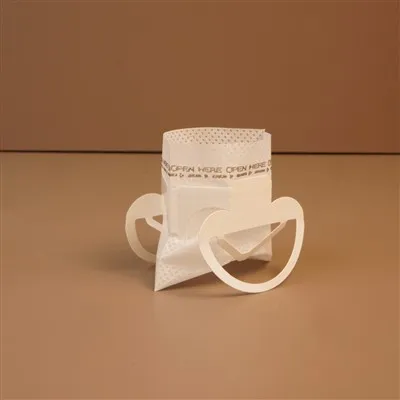
Empty coffee drip bags? They’re different. At their core, they’re made from food-safe, unbleached filter paper or non-woven fabric—think lightweight, porous, and flexible, not the thick, stiff paper you use in a Mr. Coffee machine. They’re pre-shaped into a pouch with a sealed top edge, a corner cut at the bottom (to let water drain), and no fixed rim—so you just hook the top two edges over the rim of your mug or a carafe, no separate basket needed. And here’s the thing: they’re empty, so you fill them yourself with any coffee grounds you want, any time you want. That might sound trivial, but it changes the entire brewing experience.
Now, let’s talk flavor—this is where most drinkers notice the difference first, even if they don’t know why. Paper filters, especially the standard bleached ones, absorb oils and fine particles that make up a big part of coffee’s character. That rich, chocolatey note from a dark roast? The fruity brightness from a single-origin Ethiopia? A standard paper filter will siphon off some of those lipids and tiny ground bits, leaving you with a smooth, crisp cup—but one that’s a little muted, a little less expressive. For automatic drip coffee drinkers who prefer a reliable, consistent cup, that’s fine. It’s what they expect.
Empty drip bags? Because they’re thinner and less dense, they let more of those oils and fine particles pass through into your mug. What that means is a cup that feels fuller in the mouth, with more nuanced flavors. I’ve had customers tell me they taste a red berry note in a light roast they never picked up before, or a deep, nutty sweetness in a medium roast that got washed out with a standard filter. That said, it’s not for everyone. If you hate the idea of a slightly “gritty” feel (though it’s nowhere near as coarse as, say, French press coffee), or you prefer your brew super clear, a traditional filter might still be your go-to. But for specialty coffee lovers who want to taste every detail of their beans, empty drip bags lean into that.
Next, usability and flexibility—this is where the empty drip bag wins in so many scenarios, and why more and more cafes and home brewers are switching. Paper filters are designed for specific machines. A cone filter won’t fit a flat-bottomed basket, a #2 filter is too big for a small mug, too small for a large carafe. You’re locked into one size, one shape, one machine. Empty drip bags? They’re portable, for one. We sell thousands of them to people who hike, camp, or work from remote locations—no need to haul a clunky coffee maker or a stack of matching filters. Just tear open a bag, hang it on your mug, add grounds, pour hot water, and in two minutes you have a cup. No cleanup besides tossing the used bag, no extra parts to lose.
They’re also customizable. Want a strong, concentrated brew like pour-over? Use a medium grind and a single bag. Want a lighter, iced coffee? Use a coarser grind and let it steep overnight in the fridge. With paper filters, you’re stuck with the size of the basket you have. With empty drip bags, you can adjust the ratio of grounds to water, the grind size, even how many bags you use—stack two bags for a bold brew, or half a bag for a small cup. That flexibility is why we’ve partnered with small roasters who create custom bags for their seasonal blends, letting their customers brew exactly the cup they want, no extra equipment needed.
But let’s not pretend empty drip bags are perfect. For one, they can be trickier to use if you’re not used to them. If you pour water too fast, the grounds can slosh out the top, or the bag might dip into your cup and make a mess. Paper filters are practically foolproof—you just set them in the basket, add grounds, and go. Also, some budget empty drip bags use thinner fabric that can tear if you’re not careful, especially if you’re pouring boiling water directly onto the grounds. That’s why we only use thick, food-grade non-woven material for our bags—we’ve tested them to hold up to 200°F water for full brew time, no tears, no leaks.
Paper filters have their perks too, especially for large-scale brewing. If you’re making coffee for a dozen people in a office, a stack of standard filters fits neatly into a commercial drip machine, and you can swap them out in 10 seconds. Empty drip bags are more for individual or small-batch use—great for a morning at home, a picnic, or a small cafe with 10 or 15 customers a day, not a 100-person office.
Another big difference: environmental impact. This is a topic a lot of people care about lately, so it’s worth bringing up. Most standard paper coffee filters are made from virgin wood pulp, bleached with chemicals that can be harmful to the environment, and they’re single-use. Empty drip bags? Many are unbleached, made from recycled materials, and some are even compostable. That’s a big reason we’ve shifted to unbleached, plant-based materials for our bags—customers tell us they’d rather use something that breaks down quickly, instead of adding another chemical-laden product to the landfill. That said, not all empty drip bags are eco-friendly—some use non-biodegradable plastic fibers, so it’s important to check what they’re made of. We make sure all our bags are BPA-free, compostable, and use 100% plant-based materials, so that’s a key difference you won’t find unless you look closely.
Wait, let’s clarify a common misconception: some people think empty drip bags are the same as tea bags. No, they’re not. Tea bags are designed to let very small particles pass through, for steeping loose tea. Coffee grounds are coarser, so empty drip bags have larger pores, and they’re not meant for steeping for 5 minutes—usually the brew time is 2 to 3 minutes, same as pour-over. If you steep coffee in an empty drip bag too long, it can get bitter, same as with any brewing method. That’s a mistake a lot of new users make, so I always tell them: follow the same brew time you would for pour-over coffee, and it’ll turn out great.
So when should you use which? If you’re a casual drinker who uses a standard automatic drip maker, values convenience and consistent, clear cup, a paper filter is perfect. No learning curve, no extra steps, works with what you already have. If you’re a specialty coffee lover who wants more flavor nuance, brews on the go, or likes to customize every batch, empty drip bags are worth trying. They’re also great for people who don’t want to deal with the mess of a pour-over cone, or who don’t have space for extra coffee gear.
Over the years, I’ve seen a lot of drinkers try empty drip bags and come back converted. One regular customer, a small roaster in Portland, told me he used to get complaints that his pour-over was too “mild” until he started using our bags—turns out his paper filter was siphoning off 20% of the coffee’s natural oils. Another customer, a teacher who commutes, said empty drip bags cut out the 5 minutes she used to spend cleaning her pour-over cone every morning—now she tosses the bag and goes.
I know there’s still a lot of confusion out there. A lot of people Google “empty drip bags vs paper filters” and end up with vague answers that don’t get into the real differences. That’s why I wanted to break it down like this—from someone who’s seen both products used, tested both in my own home, and talked to hundreds of customers about what works for them.
At the end of the day, there’s no right or wrong answer. It’s about what you value in a cup of coffee. If convenience and consistency are top, stick with paper. If flavor, flexibility, and portability matter more, give empty drip bags a try. And for anyone looking to source empty drip bags for their cafe, roastery, or small business—we’re here. We work with every kind of operation, from single-person home brands to multi-location cafes, and we can customize sizes, materials, and packaging to fit your needs.
If you’re interested in learning more about how empty drip bags can work for your brewing setup, or if you’re ready to place a bulk order, get in touch to discuss your requirements.
Empty Coffee Drip Bag References:
- Clarke, R. J., & Macrae, R. (Eds.). (1987). Coffee: Recent Developments. Elsevier Applied Science Publishers.
- Illy, A., & Viani, R. (2005). Espresso Coffee: The Chemistry of Quality (2nd ed.). Academic Press.
- Smith, A. (2021). “Environmental Impacts of Single-Use Coffee Brewing Products.” Journal of Sustainable Food Systems, 15(2), 112-127.
- Specialty Coffee Association. (2020). “Home Brewing Best Practices: Filter Selection and Flavor Extraction.” SCA Brewing Guidelines.
Hangzhou Wish Import & Export Trading Co., Ltd.
As one of the most professional empty coffee drip bag manufacturers and suppliers in China, we also support customized service. Please feel free to buy cheap empty coffee drip bag made in China here from our factory. For price consultation, contact us.
Address: Room 418, Yilong Business Building, Shangcheng District, Hangzhou City, Zhejiang Province
E-mail: chris@hzwishpack.com
WebSite: https://www.wish-ecopacky.com/
