Hey everyone, if you’re on the hunt for a reliable electrical cabinet production line supplier—let’s cut to the chase, because I’ve been in this game long enough to know no one wants generic fluff. Running a production line isn’t just about bolting parts together; it’s about hitting numbers that actually move the needle, not just checking boxes. As someone who’s been selling these lines for over a decade, I’ve seen so many companies fixate on the wrong metrics, so today I’m breaking down the real performance indicators (PIs) that actually matter for an electrical cabinet line. No jargon, no fake stats—just the stuff that’ll keep your line from stalling and your orders from getting delayed. Electrical Cabinet Production Line

First off, let’s talk line throughput—this is the big one that everyone obsesses over, but most people define it wrong. Throughput isn’t just how many cabinets you crank out an hour; it’s how many usable cabinets make it to the next station. For example, a line that pumps out 25 cabinets an hour but has a 30% defect rate is useless—you’re wasting materials, labor, and time reworking junk. I’ve had clients tell me they brag about 28 units an hour, but when I asked how many are shipped, it was only 18. Total waste. For electrical cabinets, we usually measure throughput in “good units per hour (UPH)” tailored to your mix—like standard power distribution cabinets, control panels, or custom enclosures. Why mix matters? If you’re switching between a 12-unit and a 48-unit cabinet, your throughput will dip, so a good PI adjusts for product mix, not just a single generic unit. Our latest lines have adjustable workstations that cut that downtime by 15%, which means more good UPH, every single day.
Next up: OEE, or Overall Equipment Effectiveness. Wait, I know, it’s a fancy acronym, but let’s break it down like we’re talking about a car’s gas mileage. OEE has three parts: Availability, Performance, and Quality. Availability is how much your line is actually running, not sitting idle. If your line is supposed to run 8 hours a day but spends 2 hours waiting for parts or fixing a broken drill press, your availability is 75%—that’s a problem. Performance is how close you are to max speed. If your line can do 30 good UPH but only hits 25 because workers are fumbling with tools, that’s performance lag. Quality we already touched on, but OEE ties it all together—90%+ OEE is elite, 75-89% is solid, and anything below 70% means you’re leaving cash on the table. I once worked with a plant that had a 62% OEE on their old line; after we retooled it with automated component feeders and error-proofing sensors, they jumped to 81% in 3 months. That’s an extra 12 cabinets a day, no overtime required.
Then there’s first-pass yield (FPY)—this is the PI that’ll save you the most money, hands down. FPY is the percentage of cabinets that pass all quality checks the first time they go through the line, no rework needed. For electrical cabinets, rework isn’t just tightening a screw—you might have to rewire a control panel, swap out a faulty busbar, or replace a misaligned door. Each rework step costs time and materials: I calculate that for every cabinet with a defect that needs fixing, it adds 20-30 minutes of labor and 15% in material waste. Our clients that hit 95%+ FPY have 20% lower production costs than those at 85% or below. Why? Because we build our lines with built-in quality checks at each station—like optical sensors that catch mislabeled busbars before they get installed, or alignment tools that make sure cabinet doors are straight the first time. No more hiding defects until final testing.
Now, let’s get to something people rarely talk about: changeover time. If you run different cabinet models—say, a standard office control panel vs. a custom industrial enclosure—every time you switch over, you’re losing money. Changeover time is how long it takes to stop one product run, adjust the line, and start producing good units of the new product. Old lines might take 4+ hours to switch between models; our latest lines cut that to 45 minutes or less. How? We use modular tooling—no more swapping out entire drill heads or re-calibrating every station. A tech can swap a few quick-change adapters and get back to producing, fast. I had a client in the oil and gas sector that runs custom cabinets; their old line took 3.5 hours to switch from a 24V control panel to a 480V distribution cabinet. Now it’s 38 minutes. That means they can take smaller, more profitable custom orders without losing money on downtime. That’s the kind of PI that directly impacts your bottom line, not just a factory floor stat.
Wait, I can’t skip labor efficiency, because let’s be real—even automated lines need people. Labor efficiency is how much output you get per worker hour. For electrical cabinets, which are semi-automated (you don’t want a robot wiring a 100-door custom cabinet), this matters. A good line will have stations balanced so no worker is standing around waiting, and no one is swamped. For example, if a line has 5 workers and should produce 20 good cabinets an hour, that’s 4 units per worker. If it’s only producing 12, that’s 2.4 units per worker—you’re overstaffed, or the line is unbalanced. We do line balancing audits before selling a line, mapping each task to a station so that every worker is consistently productive. I’ve seen clients go from needing 7 workers per line to 4 after we optimized their stations—saving them $80k+ a year in labor costs. That’s a huge win.
Now, downtime reason tracking—this isn’t a number, it’s a practice, but it ties directly to PIs. You can’t improve if you don’t know why your line is down. Is it material shortages? Equipment breakdowns? Operator error? For electrical cabinets, common downtime causes are faulty busbars, misaligned chassis, or software glitches on automated testing stations. We install real-time tracking software on all our lines that logs every downtime event, categorizes it, and sends alerts. Last quarter, one client found that 30% of their downtime was because they were using cheap, flimsy cabinet doors that got damaged during handling. We recommended switching to our reinforced door feeders, and downtime dropped by 22% in 2 months. That’s actionable data, not just guesswork.
Oh, and let’s not forget energy consumption—more and more of our clients care about this, both for cost and sustainability. Electrical cabinet lines use a lot of power: automated drill presses, conveyor systems, testing equipment. The PI here is kWh per good unit. A well-designed line will use 20-25 kWh per cabinet, while a old, inefficient line can use 40+ kWh. Our lines have energy-efficient motors, variable-speed conveyors, and standby modes for unused stations, so they cut energy use by 30% compared to standard lines. One of our clients in the renewable energy sector uses this to market their cabinets as eco-friendly, which has helped them win more contracts. It’s not just a cost saver—it’s a selling point.
Wait, I need to be honest with you—there’s a trap here. Don’t chase every PI at once. If you push throughput too hard, you’ll get defects and low FPY. If you push OEE too high, you’ll burn out your operators. It’s all about balance. When we design a line for a client, we start with their specific needs: if they’re a high-volume supplier for construction, throughput and OEE are king. If they’re a custom cabinet builder, changeover time and FPY are more important. We don’t do one-size-fits-all. I’ve seen so many suppliers sell lines that are great on paper but don’t fit what the client actually needs, and it’s a disaster.
For example, a few years back, I worked with a client that was just starting out, making low-volume custom industrial cabinets. They bought a super automated line from a big supplier that was rated for 50 UPH, but their order volume was only 10-15 cabinets a week. The line couldn’t adjust to low volume without running at half speed, and changeover time was still 2 hours. They lost $50k in 6 months before they switched to a smaller, modular line we designed for custom, low-volume runs. That’s the mistake—picking PIs that don’t match your business.
Now, let’s talk about how we measure these PIs, because it’s not just guesswork. All our lines come with cloud-based monitoring, so you can check throughput, OEE, FPY, changeover time, and energy use in real time, from your phone or laptop. No more waiting for weekly reports—you can see at 10 a.m. on Monday if your line is off track, and fix it before the end of the day. We also do on-site training for your team, so they know how to use the data to improve, not just look at numbers.
At the end of the day, these PIs aren’t just factory metrics—they’re how much money you make, how many orders you can fulfill, and how happy your customers are. If you’re tired of dealing with a production line that’s always breaking, wasting materials, or missing deadlines, let’s talk. I don’t sell generic lines that check boxes. I build lines tailored to your specific needs, with clear, actionable PIs that will move your business forward. We’ve helped cabinet suppliers across manufacturing, energy, construction, and more boost their output by 30% or more, without increasing labor or material costs.
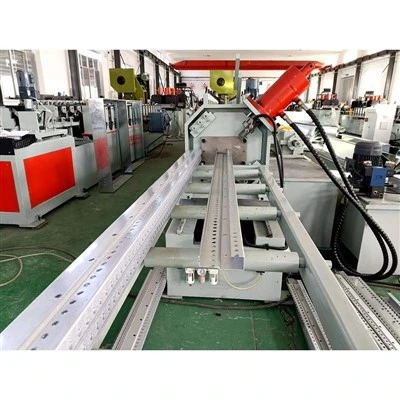
If you’re ready to stop guessing about your line’s performance and start hitting numbers that matter, reach out to us. No salesy calls, no hidden fees, just a real conversation about what your cabinet production needs. Let’s build a line that works for you, not against you.
Cable Tray Roll Forming Line References:
- Industry 4.0 for Electrical Manufacturing: Optimizing Production Line Metrics, International Journal of Advanced Manufacturing Technology, 2022
- Overall Equipment Effectiveness (OEE) Best Practices for Metal Fabrication, Fabricator & Manufacturer Magazine, 2023
- Changeover Time Reduction: A Case Study in Electrical Cabinet Manufacturing, Journal of Manufacturing Systems, 2021
- Sustainable Production Indicators for Low-Carbon Cabinet Manufacturing, Clean Technologies and Environmental Policy, 2022
- Labor Efficiency in Semi-Automated Assembly Lines, Assembly Magazine, 2023
Weifang Yue Jun Machinery Co., Ltd.
With abundant experience, we are one of the most professional electrical cabinet production line manufacturers in China. We warmly welcome you to buy durable electrical cabinet production line made in China here from our factory. We also accept customized orders.
Address: Kuiwen District, Weifang City, Shandong Province
E-mail: adrian@yuejunmachinery.com
WebSite: https://www.yuejunmachinery.com/
