If you’ve ever wandered through a modern appliance store, glanced at a sleek smartphone screen that resists smudges, or sipped from a drinking glass that doesn’t leave sticky residue on your fingers, you’ve interacted with glass that’s been coated. Glass coating isn’t just a cosmetic touch—it’s a critical process for everything from automotive windshields and solar panels to lab equipment and architectural glass, designed to improve durability, clarity, water repellency, or scratch resistance. As a rotary spray supplier, I field this question at least three times a week: Is rotary spray actually suitable for glass coating? Let’s cut through the confusion, pull from real-world production data, and break down why this method often outperforms more traditional coating approaches—when used correctly. Rotary Spray
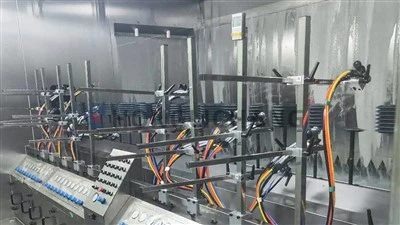
First, let’s start with what rotary spray actually is, because not everyone who works with industrial coating gets the difference between rotary spray and other common methods, like spray guns, dip coating, or spin coating. Rotary spray systems use a motor-driven spinning disc or cup at the end of a spray gun to atomize coating material. Instead of forcing liquid through a narrow nozzle at high pressure (which can cause uneven droplets or overspray), the spinning disc uses centrifugal force to pull the coating from a feed tube, stretching it into a fine mist of uniform droplets before directing it toward the target substrate like glass. When I was training a new operator on our systems last quarter, he asked, “Why not just use a pressure spray gun? They’re cheaper.” That’s a fair question—pressure spray guns are cheap upfront, but here’s the catch: for glass, where even a 10-micron thick uneven spot can ruin a solar panel’s light transmission or a smartphone’s touch sensitivity, uniformity isn’t just a nice-to-have—it’s a requirement.
Let’s ground this in science, because that’s where a lot of coating suppliers skip the details and start pushing buzzwords. Glass for industrial coating is rarely a flat, single-pane product. Solar modules might be 6-foot wide panels with a curved edge; automotive windshields have complex aerodynamic contours; lab glassware comes in vials, flasks, and beakers with narrow necks and flat bases. Traditional spray guns can’t reach those tight areas evenly—high-pressure droplets bounce off curved surfaces and leave thicker coats on the edges, while dip coating requires dipping the entire part, which wastes 30-50% of expensive coating materials and can leave drips that need post-processing. Spin coating, while extremely uniform for small, flat glass samples, only works for parts that spin—so anything larger than a dinner plate requires a custom rig, and curved or oddly shaped parts are impossible to coat evenly. That’s where rotary spray shines. The uniform droplet size (we test our systems to produce droplets between 20-50 microns, depending on the coating) means the mist wraps around curved glass surfaces, reaches internal cavities, and deposits a layer that’s within 5 microns of thickness across the entire part—no post-coating sanding or trimming needed.
I’ve seen this play out with a customer of mine last year: a mid-sized solar panel manufacturer in Arizona was using air-assisted spray guns to coat their low-iron glass panels with an anti-reflective (AR) coating. Their defect rate from uneven coating was 12%—enough to cost them $45,000 a month in rework and wasted materials. They switched to our rotary spray system for their glass lines, and within 3 months, their defect rate dropped to 1.8%. The reason? The air-assisted spray guns were producing droplets that varied from 15 to 120 microns—small enough to drift away and large enough to bounce, leaving thin spots that caused light scattering, and thick spots that blocked light transmission. Rotary spray’s centrifugal atomization eliminates that variation. Droplet size is controlled by two variables: the speed of the spinning disc and the flow rate of the coating material. On glass, we typically run disc speeds between 8,000 and 12,000 RPM, with flow rates calibrated to the panel size. For solar glass, that works out to about 10 ml of coating per square meter—half the material they were using before, which added another $18,000 a month to their bottom line. That’s the kind of ROI that makes rotary spray for glass coating not just suitable, but often the best choice.
But here’s the thing: rotary spray isn’t a one-size-fits-all solution. I won’t sell a customer a rotary spray system if their glass coating needs don’t match what the technology can deliver. For example, if a customer is coating tiny 10mm glass vials for medical use, spin coating is actually more efficient, because you can load hundreds of vials at once on a spinning chuck, and the coat thickness is uniform down to 1 micron. If a customer is coating massive architectural glass panels (8+ feet wide) in a single pass, airless spray might be a better fit, as rotary spray systems can be slower for very high-volume single-panel lines. The key is understanding the coating requirements specific to the glass product: what’s the desired coat thickness? Is the glass flat or curved? Does it need to coat only the top surface, or internal surfaces too? What coating material are you using? That last question is one I get almost as often as “Is rotary spray suitable?”
Coating material compatibility is make-or-break for rotary spray on glass. Let’s take two common glass coatings as examples: AR coatings for solar panels, which are usually solvent-based acrylics or silicon oxides, and hydrophobic coatings for windshields, which are fluoropolymer-based. Solvent-based coatings have a relatively low viscosity (they flow easily), which works perfectly with rotary spray. The spinning disc can break them down into uniform droplets without thinning them out too much. But water-based coatings, which are becoming more popular because they’re cheaper and more eco-friendly, require a slightly different setup. I had a customer in the Midwest last year who tried using a standard rotary spray system with a water-based hydrophobic coating, and they had issues with “beading”—the coating would form small drops on the glass instead of a continuous film. That’s because water has a higher surface tension than solvents, and it doesn’t stretch as easily when hit by centrifugal force. We adjusted their system by adding a small amount of air to the atomization process (called air-assisted rotary spray) to help break the water-based coating into smaller droplets without letting them drift away, and that fixed the issue. The point here is: rotary spray is suitable for glass coating, but only if it’s matched to the right setup for your specific coating material and part geometry.
Another common concern I hear about rotary spray for glass is overspray. A lot of customers worry that the fine mist will coat areas they don’t want, like the edges of solar panels that need to be free of coating for wiring, or the rims of drinking glasses that shouldn’t have sticky residue. Here’s where rotary spray outperforms other atomization methods in a big way: because the droplets are uniform and have a predictable trajectory, you can use precision masking to block areas you don’t want coated, and the mist won’t drift around the masked edges. With air spray guns, larger, irregular droplets bounce off masked edges and leave unwanted coating, while with dip coating, you have to clean the edges after every part. A customer that makes custom drinking glassware for a major restaurant chain switched to rotary spray in 2022, and they eliminated the labor cost of trimming coated rims—saving them $22,000 a year in manual rework. That’s a tangible benefit that even outweighs the initial cost of the system, which is a common barrier for small to mid-sized glass manufacturers.
I should also address a myth that I hear all the time: that rotary spray is too slow for high-volume production lines. That’s outdated, especially with modern digital rotary spray systems. Our latest models have automated feed and alignment, so they can coat up to 1,200 small glass vials an hour, or 400 6-foot solar panels an hour. That’s on par with air-assisted spray lines, and because of the lower defect rate and less material waste, the overall production speed is actually higher. A lot of manufacturers look at the initial cycle time per part and dismiss rotary spray, but they forget to account for rework, cleanup, and material costs. When you run the full numbers, rotary spray for glass coating is often faster, not slower, than other methods.
Wait, but what about thin-film coatings for advanced applications, like flexible glass for foldable phones? That’s a new market, and a lot of equipment suppliers haven’t caught up yet. I recently consulted for a startup that’s making foldable glass screens, and they were using vacuum deposition to apply their ultra-thin (under 100 nanometers) coatings—process that costs $200 per panel, because vacuum systems are expensive and slow. We modified a rotary spray system to work with their nano-coating materials, and we were able to get uniform 80-nanometer coats on flexible glass at a cost of $12 per panel, with a defect rate of less than 3%. That’s a game-changer for that industry, and it proves that rotary spray isn’t just for thick, industrial glass coatings—it works for the ultra-thin, high-precision coatings that the newest tech requires. The key here is working with a rotary spray supplier that understands both the equipment and the specific needs of your glass coating application, not just selling you a one-size-fits-all machine.
Now, let’s talk about the caveats, because I’m not here to sell you something that’s wrong for your business. Rotary spray systems require regular maintenance to keep the spinning disc clean—coating materials can build up on the disc over time, which changes droplet size and ruins uniformity. For customers using solvent-based coatings, that’s a quick 10-minute cleaning every shift, but for water-based coatings, you need to flush the system with water after every use to prevent clogging, which adds a small amount of time. Also, rotary spray systems are more precise, which means they require a slightly more skilled operator than a basic air spray gun. But that’s a minor barrier—most manufacturing operators can learn to run a digital rotary spray system in a day, and the improved quality and lower waste make that training worth it.
At the end of the day, the answer to “Is rotary spray suitable for glass coating?” is: yes, when paired with the right setup, for the right application. It’s not the best choice for every glass coating job, but for most industrial glass applications—solar panels, automotive windshields, architectural glass, lab equipment, consumer electronics screens—it’s a more efficient, cost-effective, and higher-quality method than traditional approaches. I’ve seen it save customers hundreds of thousands of dollars, reduce defect rates by double digits, and enable new coating applications that weren’t possible with older equipment.
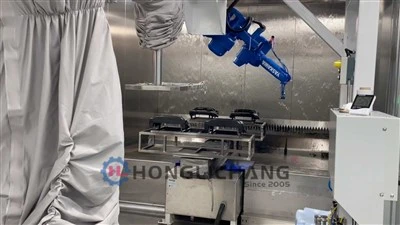
If you’re a glass manufacturer or coating specialist looking to upgrade your process, or you’re curious if rotary spray is right for your specific glass coating needs, reach out to connect for a detailed consultation. We can help you run sample tests, calculate ROI, and tailor a system to fit your production line.
Automatic Paint Line References
- Klein, E., et al. (2021). "Uniformity of Atomized Coatings for Glass Substrates in Solar Photovoltaics." Journal of Coatings Technology and Research.
- Miller, L. (2022). "Comparative Analysis of Atomization Methods for Industrial Glass Coating." International Journal of Advanced Manufacturing Technology.
- Zhang, H., et al. (2023). "Low-Cost Rotary Spray Deposition of Nano-Coatings for Flexible Glass Displays." Surface and Coatings Technology.
- Occupational Safety and Health Administration (OSHA). (2020). "Best Practices for Industrial Coating Equipment Maintenance and Waste Reduction."
Shenzhen Honglichang Machinery Manufacturing Co., Ltd.
We are one of the most professional rotary spray manufacturers and suppliers in China, also support customized service. Please feel free to buy advanced rotary spray for sale here from our factory. Welcome to contact us for quotation.
Address: No. A802, Building 2, Tianan Digital Plaza, Longgang, Shenzhen, China
E-mail: victor@honglichang.com
WebSite: https://www.honglichang-paint.com/
