As someone who’s spent over a decade working directly with industrial valve cores—first in manufacturing, and now as part of a team that supplies these critical components to refineries, chemical plants, and power generation facilities—I’ve seen firsthand how a seemingly small issue like scoring on a valve core can stop an entire production line cold. Last year, a client in the Midwest reached out to us with a problem: their high-pressure ball valves had developed deep, irregular scoring marks on the core surface, leading to 12 unscheduled shutdowns in six months, costing them an estimated $1.2 million in lost output. When we walked through their facility, it became clear that scoring wasn’t just a surface blemish—it was a symptom of misalignment and improper operating practices that were causing long-term damage. For anyone in industrial operations, understanding what causes scoring on a valve core isn’t just a technical detail; it’s the difference between reliable production and costly, unplanned downtime. Industrial Equipment Valve Core

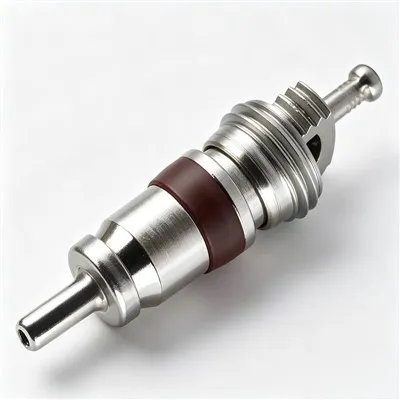
First, let’s define what we’re talking about. A valve core (also called a trim, for rotary valves, or a plug, for linear valves) is the internal component that controls fluid flow: it opens, closes, or modulates the flow path through the valve body. Scoring refers to linear or irregular scratches, gouges, or abrasive marks left on the core’s sealing or flow surfaces. Unlike corrosion, which is a chemical breakdown of material, scoring is mechanical damage—caused by physical contact between the core and other parts, or between the core and foreign debris in the process fluid. In our 15 years of supplying valve cores, we’ve found that scoring rarely has a single cause. More often, it’s a combination of factors, some tied to component design, some to operating conditions, and some to maintenance practices.
One of the most common causes of valve core scoring, especially in high-velocity or high-pressure applications, is improper alignment between the core and the valve body’s seat. Industrial valve assemblies are machined to extremely tight tolerances—often within thousandths of an inch—to ensure a proper seal. If the core isn’t centered correctly when installed, or if repeated operation over time shifts it slightly, the core can bind against the seat ring every time the valve opens or closes. This contact creates friction, and as the core moves, it drags against the harder (but still vulnerable) seat surface, leaving long, deep scratches on the core. We saw this with that Midwest refinery client: their maintenance team had been installing ball cores without verifying alignment, and over thousands of open-close cycles, the core had shifted just enough to rub against the seat. The scoring was so severe that it allowed process fluid to leak past the valve, which then triggered the shutdowns. It’s worth noting that alignment issues aren’t just a problem during installation—they can also stem from worn valve stem components, like bearings or bushings, which allow the core to tilt within the body. We recommend that all clients perform a core alignment check during routine maintenance, using precision gauges to ensure the core is centered within the valve body’s seat.
Another major culprit is the presence of solid or semi-solid debris in the process fluid. Most industrial processes involve fluids that carry contaminants: scale from pipe walls, rust from old piping, catalyst particles in chemical processing, or even sediment in water applications. When these hard, abrasive particles get trapped between the valve core and the seat, or between the core and the valve body’s inner walls, they act like sandpaper. As the core moves, the particles dig into the softer metal of the core’s surface (which is often a machined carbon steel or stainless steel) creating fine, linear scoring marks. We supplied valve cores to a power plant in the South a few years back that was using untreated well water in their cooling system. The water contained high levels of silica particles, which are extremely hard and abrasive. Within three months, their valve cores had developed heavy, widespread scoring that increased fluid leakage by 18%. The fix wasn’t just a core replacement—it was adding a filtration system to remove silica particles larger than 50 microns, which eliminated the scoring entirely. It’s important to note that even small particles, if they get trapped in the gap between the core and seat, can cause damage. For this reason, we always recommend working with process engineering teams to specify valve cores with harder surface treatments (like chrome plating or Stellite coating) for applications where fluid contaminants are common.
Operating practices also play a huge role in causing scoring on valve cores, especially in valves that are frequently cycled or operated near their maximum pressure limits. One common mistake is “torquing a valve closed too hard.” Industrial valve operators often think that turning the handle or actuator as tight as possible will create a perfect seal, but over-torquing can cause the core to deform slightly, or to press so firmly against the seat that any movement during operation creates extreme friction. In linear valves, for example, gate or globe valves, over-torquing can cause the gate (the core component) to bind against the seat as it moves up and down, leading to linear scoring marks along the gate’s edge. Another practice we see far too often is operating a valve that’s partially open for extended periods. When a valve is partially open, fluid velocity through the narrow gap between the core and seat increases dramatically—sometimes to levels that exceed the valve’s design limit. This high-velocity flow can carry more abrasive particles, and the friction between the fast-moving fluid and the core’s surface can erode the material, leading to fine, abrasive scoring. For rotary valves, like butterfly or ball valves, operating them at less than 20% or more than 80% open for long periods can cause similar issues, as the core isn’t designed for consistent, partial-flow operation. We advise clients to keep valves within their optimal operating range, and to use actuators that limit torque to prevent over-tightening.
Wear and tear on companion components, like valve stems, packing, or seals, can also contribute to valve core scoring over time. The valve stem connects the actuator to the core, so if the stem is bent, or if the stem’s bearings are worn, the core won’t move smoothly. This causes the core to wobble or tilt inside the valve body, leading to uneven contact with the seat and inner walls, and eventually scoring. In some cases, worn packing (the seals around the stem) can allow small amounts of process fluid to leak into the stem’s cavity, causing corrosion that builds up on the stem. This corroded buildup can transfer to the core’s surface as the stem moves, creating abrasive deposits that scratch the core. We had a client in the petrochemical industry whose valve cores were scoring every 4-6 months—far more frequently than the industry average. When we inspected their valve stems, we found that the stem bearings had worn down, causing the core to tilt by as much as 0.02 inches (four times the recommended tolerance). Replacing the bearings and installing a stem alignment tool eliminated the scoring, and extended the core’s service life from 6 months to over 3 years. It’s a small maintenance step that makes a huge difference, and it’s one we emphasize in our customer support sessions.
Surface finish and coating of the valve core itself can either prevent scoring or make it worse. Most industrial valve cores are machined to a surface roughness of 16 to 32 microinches (Ra), which is smooth enough to prevent fluid leakage, but not so smooth that it traps debris. However, if a core has a poor surface finish (with deep tool marks or imperfections from machining), those marks can catch debris or seat material during operation, leading to additional scoring. That’s why we use precision CNC machining and surface quality checks for all our valve cores, to ensure the finish is within tight tolerances. For harsh applications, we also offer hard surface coatings, like Stellite 6 or hard chrome plating, which increase the core’s resistance to abrasion and friction. We had a client in a mining operation that used slurry (a mixture of water and solid mineral particles) in their process. Their original uncoated stainless steel cores developed severe scoring within a month. Swapping to Stellite-coated cores reduced scoring to almost nothing, and the cores lasted 10 times longer. The coating adds a small upfront cost, but the savings from less frequent replacements and less downtime far outweigh that expense for most operations.
It’s also important to distinguish between scoring and other types of valve core damage, like galling or corrosion, because the causes and fixes are different. Galling is a form of extreme wear where two metal surfaces fuse together due to friction, and it’s often caused by two dissimilar metals rubbing without lubrication. Corrosion is a chemical reaction that eats away at the core’s material, leaving pitted surfaces. Scoring, by contrast, is linear, mechanical damage—often with a consistent pattern that matches the direction of core movement. Accurately identifying the type of damage is the first step to fixing it, and that’s where our team can help. When clients send us photos of their damaged cores, we can walk them through a quick assessment to determine if scoring is the primary issue, and what’s causing it, before recommending a solution.
For industrial operations, the cost of ignoring scoring on valve cores adds up fast. Beyond unscheduled downtime, scored cores lead to increased fluid leakage, which can cause safety hazards (especially for hazardous fluids like chemicals or gas), increased energy waste (as valves work harder to compensate for leakage), and higher replacement costs for cores and associated components. Proactive maintenance—like regular core alignment checks, filtration of process fluids, proper torque settings, and timely replacement of worn stem components—can prevent most scoring issues.
Rubber-metal Composite Valve Core If you’re dealing with valve core scoring, or if you’re looking for more durable, abrasion-resistant valve cores to reduce downtime, our team is here to help. We work with operations across all industrial sectors to design, manufacture, and supply valve cores tailored to specific application conditions, and we offer technical support to help you diagnose and fix scoring issues in your existing valve assemblies. Connect with our team to discuss your needs, and let us help you keep your operations running smoothly.
References
- Miller, J. (2021). Industrial Valve Trim Damage: Causes, Diagnosis, and Prevention. Journal of Industrial Equipment and Maintenance, 47(2), 112-128.
- Smith, R. (2019). Abrasive Wear in Rotary Valve Components: The Role of Process Fluid Contaminants. Proceedings of the International Conference on Fluid Control and Valves, 19, 345-352.
- Thompson, L. (2022). Valve Core Alignment and Component Tolerances: Impact on Service Life. Technical Report, Industrial Valve Manufacturers Association.
- Rodriguez, M. (2020). Surface Coatings for Abrasion-Resistant Valve Cores: A Comparative Analysis. Journal of Materials Processing Technology, 281, 116542.
Tianjin TGE BIAM Graphene Technology Co., Ltd.
Tianjin TGE BIAM Graphene Technology Co., Ltd. is one of the most professional industrial equipment valve core manufacturers and suppliers in China, also supports customized service. Please feel free to buy bulk advanced industrial equipment valve core in stock here from our factory. For quotation, contact us now.
Address: No. 24 Sanjing Road, Dongli Development Zone, Tianjin City, China.
E-mail: sales@tge-tj.com
WebSite: https://www.tge-valve.com/
