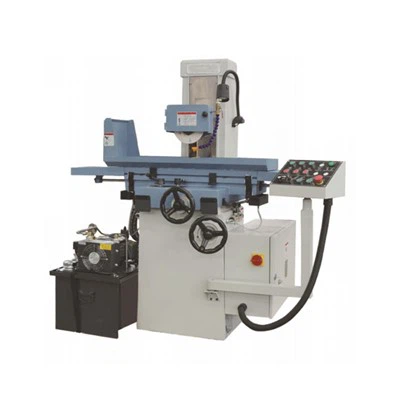
As a supplier of precision surface grinders, I’ve had the privilege of witnessing firsthand the critical role that cutting force plays in the world of precision machining. In this blog post, I’ll delve into the concept of cutting force in a precision surface grinder, exploring its significance, factors influencing it, and how it impacts the overall performance of the machine. Precision Surface Grinder
Understanding Cutting Force
Cutting force is the force exerted by the grinding wheel on the workpiece during the grinding process. It is a complex interaction between the abrasive grains of the grinding wheel and the material being ground. This force is essential for removing material from the workpiece, but it also has a significant impact on the quality of the finished surface, the tool life, and the overall efficiency of the grinding operation.
The cutting force can be divided into three components: tangential force, radial force, and axial force. The tangential force is the force that acts in the direction of the grinding wheel’s rotation and is responsible for removing material from the workpiece. The radial force acts perpendicular to the surface of the workpiece and can cause deflection and vibration, which can affect the accuracy of the grinding process. The axial force acts parallel to the axis of the grinding wheel and is typically much smaller than the tangential and radial forces.
Significance of Cutting Force
The cutting force in a precision surface grinder is crucial for several reasons. Firstly, it determines the material removal rate. A higher cutting force generally results in a faster material removal rate, but it also increases the risk of overheating and damage to the workpiece and the grinding wheel. Therefore, it is essential to find the optimal cutting force to balance the material removal rate with the quality of the finished surface.
Secondly, the cutting force affects the surface finish of the workpiece. Excessive cutting force can cause surface roughness, burns, and cracks, while too little cutting force may result in incomplete material removal and a poor surface finish. By controlling the cutting force, we can achieve the desired surface finish and dimensional accuracy.
Thirdly, the cutting force has a significant impact on the tool life of the grinding wheel. High cutting forces can cause rapid wear and tear of the abrasive grains, reducing the lifespan of the grinding wheel. By optimizing the cutting force, we can extend the tool life and reduce the cost of grinding operations.
Factors Influencing Cutting Force
Several factors influence the cutting force in a precision surface grinder. These include:
- Grinding Wheel Characteristics: The type, grit size, and hardness of the grinding wheel can significantly affect the cutting force. A harder grinding wheel generally requires a higher cutting force, while a finer grit size can reduce the cutting force and improve the surface finish.
- Workpiece Material: The material being ground also plays a crucial role in determining the cutting force. Different materials have different hardness, toughness, and machinability, which can affect the cutting force required for material removal.
- Grinding Parameters: The grinding parameters, such as the grinding speed, feed rate, and depth of cut, can have a significant impact on the cutting force. Increasing the grinding speed or feed rate generally increases the cutting force, while increasing the depth of cut can also increase the cutting force.
- Coolant and Lubrication: The use of coolant and lubrication can reduce the cutting force by reducing friction and heat generation. Coolants can also help to flush away the chips and debris, improving the surface finish and tool life.
Measuring and Controlling Cutting Force
To ensure the optimal performance of a precision surface grinder, it is essential to measure and control the cutting force. There are several methods for measuring cutting force, including dynamometers, strain gauges, and load cells. These devices can provide real-time feedback on the cutting force, allowing operators to adjust the grinding parameters to optimize the cutting process.
Controlling the cutting force can be achieved through several methods, including:
- Optimizing Grinding Parameters: By adjusting the grinding speed, feed rate, and depth of cut, operators can control the cutting force and achieve the desired material removal rate and surface finish.
- Selecting the Right Grinding Wheel: Choosing the appropriate grinding wheel for the workpiece material and grinding operation can significantly reduce the cutting force and improve the tool life.
- Using Coolant and Lubrication: The use of coolant and lubrication can reduce the cutting force by reducing friction and heat generation.
- Monitoring and Adjusting the Grinding Process: Regular monitoring of the cutting force and other grinding parameters can help operators identify any issues and make adjustments to the grinding process to optimize performance.
Impact on Precision Surface Grinder Performance
The cutting force in a precision surface grinder has a significant impact on the overall performance of the machine. By understanding and controlling the cutting force, we can achieve the following benefits:
- Improved Surface Finish: By optimizing the cutting force, we can reduce surface roughness, burns, and cracks, resulting in a smoother and more accurate surface finish.
- Increased Tool Life: By reducing the cutting force, we can extend the tool life of the grinding wheel, reducing the cost of grinding operations.
- Enhanced Dimensional Accuracy: By controlling the cutting force, we can minimize deflection and vibration, resulting in improved dimensional accuracy of the workpiece.
- Increased Productivity: By optimizing the cutting force, we can increase the material removal rate, reducing the time required for grinding operations and increasing productivity.
Conclusion

In conclusion, the cutting force in a precision surface grinder is a critical factor that affects the quality of the finished surface, the tool life, and the overall efficiency of the grinding operation. By understanding the concept of cutting force, the factors influencing it, and how to measure and control it, we can optimize the performance of the precision surface grinder and achieve the desired results.
Vertical Surface Grinder As a supplier of precision surface grinders, we are committed to providing our customers with the highest quality machines and technical support. If you are interested in learning more about our precision surface grinders or have any questions about cutting force or other grinding-related topics, please contact us to discuss your specific needs and requirements. We look forward to working with you to achieve your precision machining goals.
References
- Malkin, S. (1989). Grinding Technology: Theory and Applications of Machining with Abrasives. John Wiley & Sons.
- Trent, E. M., & Wright, P. K. (2000). Metal Cutting. Butterworth-Heinemann.
- Shaw, M. C. (2005). Metal Cutting Principles. Oxford University Press.
Wuxi Mingxu Machinery Equipment Co., Ltd.
As one of the most professional precision surface grinder manufacturers and suppliers in China, we’re featured by quality products and good price. Please rest assured to buy the best precision surface grinder for sale here from our factory. Also, custom service is available.
Address: No. 5-5 Jinke Wealth Plaza, Changjiang North Road, Xinwu District, Wuxi City, Jiangsu Province
E-mail: yingyingmxjd@163.com
WebSite: https://www.mingxu-china.com/
