Hey there! I’m a supplier of unequal length double end studs, and today I wanna chat about the thermal expansion coefficient of these little guys. Unequal Length Double End Studs

So, let’s start with the basics. What the heck is a thermal expansion coefficient? Well, in simple terms, it’s a measure of how much a material expands or contracts when its temperature changes. Every material out there has its own unique thermal expansion coefficient, which is super important to know, especially when you’re dealing with things like unequal length double end studs.
Unequal length double end studs are pretty cool. They’ve got threads on both ends but with different lengths, which makes them super useful in a bunch of applications. You can find ’em in engines, machinery, and all sorts of industrial equipment. But here’s the deal: when the temperature around these studs changes, they’re gonna expand or contract, and if you don’t know how much, that could spell trouble.
The thermal expansion coefficient is usually denoted by the Greek letter α (alpha). It’s defined as the fractional change in length per degree change in temperature. For example, if you’ve got a stud that’s 10 inches long and it has a thermal expansion coefficient of 10 x 10^-6 /°C, and the temperature goes up by 50°C, the change in length (ΔL) can be calculated using the formula ΔL = α * L * ΔT. Plugging in the numbers, we get ΔL = (10 x 10^-6 /°C) * 10 inches * 50°C = 0.005 inches. That might not seem like a lot, but in some precision applications, even a tiny change in length can cause problems like misalignments or stress on the components.
Now, the thermal expansion coefficient of unequal length double end studs depends on the material they’re made of. Common materials for these studs include steel, stainless steel, and alloy steel. Each of these materials has its own range of thermal expansion coefficients.
Steel, for instance, typically has a thermal expansion coefficient in the range of about 10 – 13 x 10^-6 /°C. This means that for every degree Celsius increase in temperature, a steel stud will expand by about 10 to 13 millionths of its original length. Stainless steel, on the other hand, has a slightly different range. Austenitic stainless steels usually have a thermal expansion coefficient around 16 – 18 x 10^-6 /°C. The difference in these coefficients is due to the different chemical compositions and crystal structures of the materials.
Alloy steels can have a wide range of thermal expansion coefficients depending on the specific alloys added. For example, adding elements like nickel, chromium, or molybdenum can change the properties of the steel, including its thermal expansion behavior. Some high – nickel alloy steels might have a lower thermal expansion coefficient, which can be beneficial in applications where you want to minimize the effects of temperature changes.
Why is it so important to know the thermal expansion coefficient of unequal length double end studs? Well, think about it. In a high – temperature environment like an engine, the studs are gonna be exposed to significant temperature variations. If the studs expand too much or too little compared to the surrounding components, it can lead to problems. For example, if the studs expand more than the parts they’re holding together, they could cause excessive stress on the joints, leading to leaks or even component failure. On the other hand, if they expand less, the joints might loosen up, which can also be a big issue.
As a supplier, I always make sure to provide my customers with accurate information about the thermal expansion coefficient of the studs I sell. That way, they can make informed decisions when it comes to choosing the right studs for their applications. If a customer is working on a project in a high – temperature environment, I’ll recommend studs made of materials with lower thermal expansion coefficients to minimize the impact of temperature changes.
Another thing to keep in mind is that the thermal expansion coefficient can also affect the installation process. When installing unequal length double end studs, you need to take into account the temperature at the time of installation and the expected temperature range during operation. If you install the studs at a low temperature and they’re gonna be used in a high – temperature environment, you need to make sure there’s enough room for expansion. Otherwise, the studs could get over – stressed and break.
I’ve also seen cases where customers have used the wrong studs without considering the thermal expansion coefficient. One time, a customer was using regular steel studs in a high – temperature application where they should’ve used a high – nickel alloy steel. The studs expanded too much, and it caused the components to warp and eventually fail. After that, we had a long conversation about the importance of choosing the right studs based on the thermal expansion coefficient.
So, if you’re in the market for unequal length double end studs, make sure you pay attention to the thermal expansion coefficient of the materials. It can make a huge difference in the performance and longevity of your equipment.
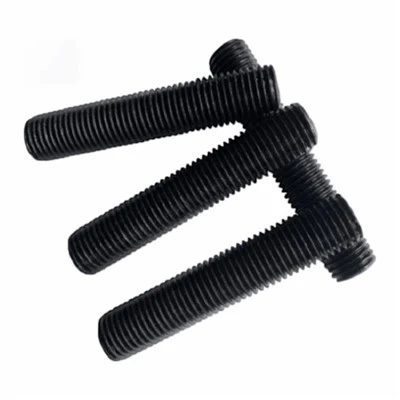
If you’re looking for high – quality unequal length double end studs and want to learn more about their thermal expansion coefficients and which materials are right for your application, don’t hesitate to reach out. I’m here to help you make the best choice and ensure that your projects run smoothly. Whether you’re working on a small DIY project or a large – scale industrial application, I’ve got the studs and the knowledge to meet your needs. Just come and have a chat with me about your requirements, and we can figure out the perfect solution together.
Stud Bolts References
- "Materials Science and Engineering: An Introduction" by William D. Callister Jr. and David G. Rethwisch
- "Mechanical Engineering Handbook" by Myer Kutz
Handan Jihao Fastener Co., Ltd.
We’re known as one of the most professional unequal length double end studs manufacturers and suppliers in China. With abundant experience, we warmly welcome you to wholesale customized unequal length double end studs made in China here from our factory. If you have any enquiry about cooperation, please feel free to email us.
Address: A2, Row 31, Feiyu Screw World, Hebei Pu, Linmengguan Town, Yongnian District, Handan City, Hebei Province
E-mail: wenzhaona0@gmail.com
WebSite: https://www.chinaboltnut.com/
